Sport in Las Palmas: What We Run and What the Island Adds
Gran Canaria is often called a miniature continent, and for anyone who likes moving that is not just a tourism slogan. Within an hour of the front door you can be surfing a beginner break, climbing volcanic rock, or running a ridge line at 1,500 metres. The weather cooperates all year, which is the real luxury: there is no off-season to train around.
This guide has two halves. First what we organise or equip you for - and those are two different things, so each entry says which. Then the sports that are simply easy from here: we have no hand in them at all, but the water is under 500 metres away and the island does the rest. Equipment list in What's Included.
Before You Book: One Honest Caveat
Nothing on this list is a booked programme with fixed dates. Our sessions depend on the season, on the weather, and on who happens to be in the house that month. The same goes for everything the island offers: courses, clubs and rentals run when they run, and a sailing course or a surf lesson in a given week is never guaranteed.
So if one particular sport is the reason you are coming, please ask us before you book whether it is realistic for your dates. We would much rather tell you honestly in advance than have you arrive for something that is not happening that month.
Organised or Equipped by Us
We host up to 8 organised sessions per month, depending on the season, who is currently here, and which trainers are available. Two things follow from that, and they apply to every session on this page, yoga included: sessions are organised according to demand, and some of them only on request. A class with a single participant gets called off; a session that several people want tends to happen. In summer this is the rule rather than the exception - sessions then run only if enough people are interested.
So say what you want. If you are after acro-yoga, a Run & Brunch, rescueboarding or an ice bath, tell us - that is often what turns it into a date in the calendar, and it works all year round. There is no closed season for any of it.
The rest is equipment rather than organisation. The volleyball net, the racing bike and the rescue board are there to be taken out; nobody schedules anything for you. Participation in everything is optional - more on the thinking behind that in Sport Is Not an Add-On.
Where all of this happens
Our three houses sit in blue. The orange dots are the spots this guide keeps referring to - courts, pools, studios and gyms, all of them walkable or a short ride away.
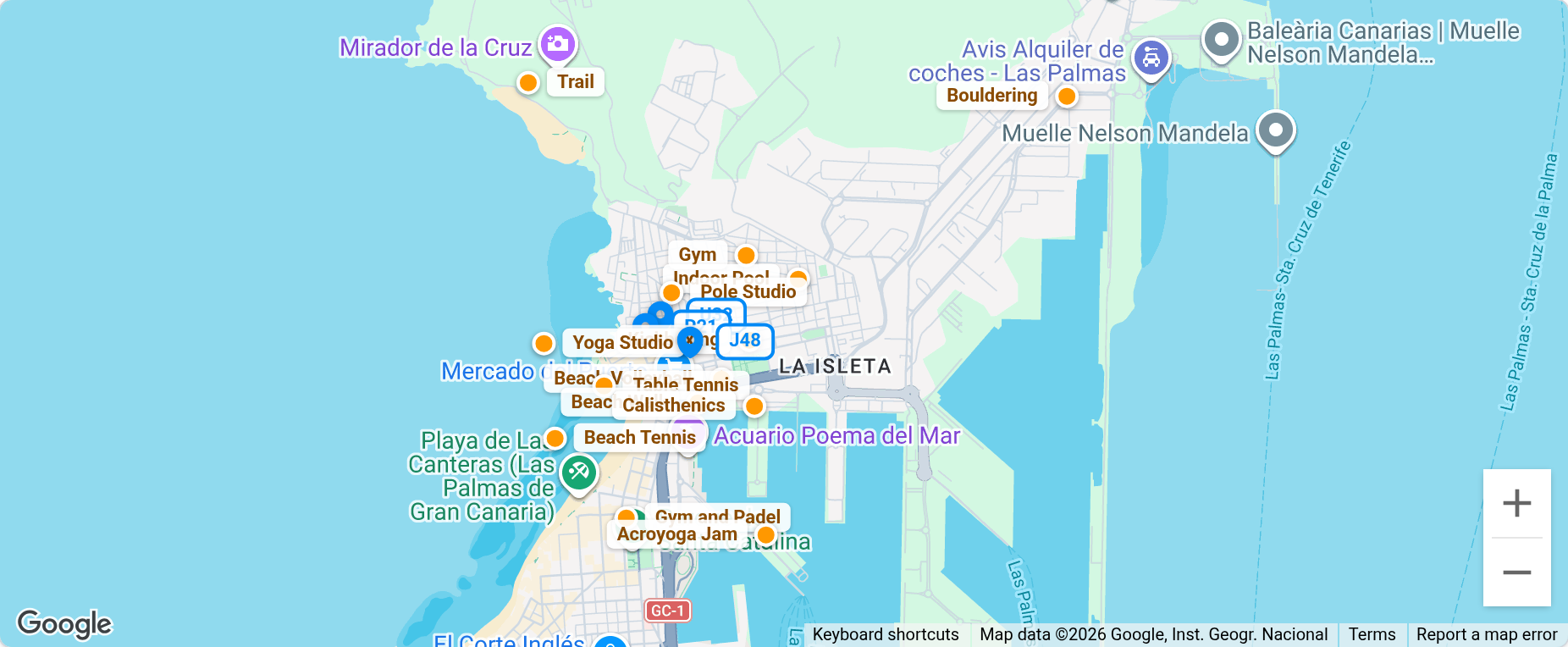
- No Limits Pole Studios · 240 m* – Pole dance studio, until the area planned in the house exists.
- Piscina León y Castillo · 300 m* – Municipal indoor pool, 25 m and seven lanes. Weekdays only.
- Isleta Fitness Center · 340 m* – The nearer of the two gyms.
- Table tennis tables · 350 m* · free – Free public tables. No Google Maps entry either, so again the pin is the spot.
- Beach volleyball courts · 400 m* · free – Public courts on the nearest stretch of beach. Bring our net and balls.
- Calisthenics park · 430 m* · free – Free public calisthenics park. It has no Google Maps entry, so the pin is the spot itself.
- Power Yoga Canarias · 440 m* – Recommended studio, including genuinely advanced classes, with a sea view.
- Beach walk · 500 m* · free – Walks on the sand or along the promenade beside it - the easiest daily movement there is here.
- Beach tennis courts · 680 m* · free – Free public courts further along Las Canteras.
- Dreamfit · 980 m* – Larger gym, and the nearest padel courts.
- Acroyoga Jam spot · 1070 m* · free – Where the weekly Acroyoga Jam meets, by the ship's propeller monument on the promenade.
- Trail running route · 1350 m* · free – The trail starts at the door and runs about 8 km. This pin sits roughly in its middle, not at either end.
- Indoorwall Gran Canaria · 1930 m* – Indoor bouldering gym, and the only spot on this map you would not walk to.
- AMK1 Kickboxing · 100 m* – Boxing and kickboxing school, essentially around the corner.
* Straight-line distance from the U32 Headquarter, so the actual walk is longer. The three blue pins are our houses.
Acro-Yoga - organised
Partner acrobatics is one of the sports this place was built around. Sessions happen on the sport rooftop terrace and, when the weather invites it, down on the beach at Las Canteras. You need neither experience nor a partner: most people start at an introduction workshop run by Thomas, and afterwards small groups of two to four keep practising on their own. It is one of the four things we will try to arrange on request if the timing works.
The basics come first - bird, throne, folded leaf, and above all how to spot properly, because that is what makes the rest safe to try. There are 20 m² of tatami mats in the laundry room for floor work, and the rooftop has the space for everything else.
As of August 2026 there is also a weekly Acroyoga Jam on the promenade, at the ship's propeller monument. A jam is not an organised class - it is closer to a dance party: everyone trains, plays around and tries whatever they feel like. If you are completely new you will usually find someone happy to show you the basics, and beyond that people teach, support and spot each other as needed. If you have done any yoga, climbing, calisthenics or pole dance, you will probably pick up the basic positions quickly. Anyone can join. More on Acro-Yoga here.
Yoga - organised
The most regular of the organised sessions: usually once a week in winter and every two weeks in summer, on the rooftop terrace. The styles actually taught here are Vinyasa, Ashtanga, Rocket and Power Yoga - the flow-based end of the spectrum, strong on breath and transitions rather than long held shapes. Which one comes up depends on who is teaching.
Every room comes with its own yoga mat in your room colour, so the terrace is also just there whenever you feel like it. Open to every level, and nobody checks whether you have done it before. More on Yoga here.
If you want more than we run, or something more advanced, Power Yoga Canarias is the studio we recommend - genuinely advanced classes among others, and a sea view, about 450 metres away.
Trail Running - organised
When we run together, it is usually on trails rather than on tarmac - including the scenic coastal routes, which are trails too. The trail up La Isleta starts at the door and runs about 8 km: no drive, no bus, no warm-up along a road first. The surface changes every few hundred metres and the view is the point. Our Run & Brunch sessions are an easy group run followed by breakfast, and they are one of the four things we will try to arrange on request.
For flat mileage on your own, the Las Canteras promenade is right there: traffic-free, roughly 2.5 km end to end, so an out-and-back gives you 5 km without a single road crossing. The La Isleta headland adds real elevation inside the city. If you want a target to train for, the Transgrancanaria crosses the island every winter and draws an international ultra field. The hiking section below covers the areas these trails run through.
Rescueboarding - equipment, and organised on request
The most unusual sport on this list. Rescueboarding comes out of lifesaving: the board is what a lifeguard reaches for when someone is in trouble away from the shore, because it gets you out through the water far faster than swimming and gives you something solid to pull an exhausted person onto. It is also a competition discipline, with board races around a buoy course and board rescue events - one of the few sports where the race and the actual job are the same movement.
We keep a professional rescue board here and you can take it out yourself, all year round. Las Canteras is an unusually good place to learn on: the reef takes the worst out of the swell, so the sheltered water stays flat enough to get the paddling technique and the prone-to-knees transition right. No club membership and no licence needed. If you have never been on one, ask first - getting on and off a board in moving water is worth being shown once, and a proper session is something we will try to arrange if you ask. More on Rescueboarding here.
Ice Bathing - organised on request
Not a sport exactly, but it runs on the same rhythm as the rest: announced in the chat, entirely optional, available all year round on request, and much easier with other people standing next to you. The Atlantic here sits around 19 to 24 °C depending on the season, so this is genuine cold exposure rather than a novelty, and it pairs naturally with whatever you did on the rooftop that morning.
Beach Volleyball - equipment
We do not organise games, but we keep a volleyball net and balls at the HQ, free for residents to take out. There are public courts on the stretch of beach closest to the house - under 500 metres away, so the whole undertaking is a five-minute walk with a net over your shoulder. A second set of courts sits roughly another 500 metres along the beach if the first is busy.
This is the classic spontaneous session: someone posts in the chat, a few people walk down, the net goes up. Levels range from complete beginners to people who clearly played in a league somewhere, and both are normal. If you take the net out, you are responsible for bringing it back in good condition - that one is in the house rules.
Cycling - equipment
Also not organised: we equip you, you ride. There is a racing bike at the HQ, hanging over the desk in the living room, available for training rides and longer tours around the island. Since there is only one, availability is not guaranteed, so ask. It is too valuable to leave unattended outside, and whoever takes it brings it back in good condition.
Indoors there is a stationary bike in the living room for the days when the wind or the Calima makes outside unappealing, and an under-desk bike in the coworking space, which turns a working day into a moving one without costing you any time.
For getting around the city rather than training, the Sítycleta bike-sharing network has stations all over Las Palmas and costs a few euros a month. Details and rental shops in Getting Around by Bike. And the island itself is a well-known winter base for road cyclists: sustained climbs of 20 km and more, in shorts, in February. The Tamadaba ascent along the west coast is one of the signature ones. More on Cycling here.
Handstand Training and Calisthenics - organised
We run these as sessions too, on the same demand-driven basis as the rest. The rooftop has push-up bars and open floor space, and the HQ has pull-up and dip bars, weights, resistance bands and a battle rope. In practice handstand work, calisthenics and acro blur into each other - same corner, often the same session, and the people are the same people.
It is also the easiest thing here to do alone at an odd hour - no session to wait for, no partner needed.
Pole Dance - planned
Like the bouldering wall, an area for pole dance is planned in the house. It does not exist yet, and there is no date on it.
Until then there is a pole studio around 350 metres away - close enough that it is a shorter walk than the beach. It also happens to be one of the disciplines that transfers well into acro-yoga, so the two tend to attract the same people.
Climbing and Bouldering - planned
A bouldering wall is planned for the house. It is not built yet and we are not putting a date on it, so treat this as a coming attraction rather than something you can use on arrival.
For indoor climbing in the meantime there is Indoorwall Gran Canaria, a bouldering gym on the far side of the port. It is the one spot on our map you would not walk to, but it is a short ride and the obvious place to keep training between trips outside.
Outdoors, the main sport-climbing area is in Tamadaba Natural Park near Artenara, with several hundred bolted routes of mostly moderate difficulty on walls up to around 40 metres, on volcanic rock in pine forest with very few people around. That one is a drive rather than a bus ride, so it tends to be a weekend plan with someone who has a car. Worth asking around the house - climbers find each other quickly.
Easy From Here
None of the following has anything to do with us. All of it is close, several of these are the reason people extend their stay, and the first one is the single biggest argument for the location. For how to reach the ones outside the city, see Getting Around Without a Car.
Swimming
We do not organise swimming, and we do not need to: the water is under 500 metres from the door. Las Canteras is sheltered by a natural rock barrier called La Barra, which turns most of the beach into a calm lagoon and is why the city has a serious year-round swimming culture. Water temperature runs roughly 19 to 24 °C through the year, so a good part of the season needs no wetsuit. Locals swim laps parallel to the shore all morning, and you will not be alone out there in January.
If you want lanes and a clock, the nearest option is the municipal indoor pool Piscina León y Castillo, about 400 metres away: 25 metres, seven lanes, covered, open on weekdays and closed at weekends. For most people staying here, that plus the ocean covers it.
There are also swimming clubs with 50-metre Olympic pools in the city, among them the Metropole Swimming Club by Parque Romano and the municipal Julio Navarro pool in Parque Doramas. Both are worth knowing about if you swim seriously - but they work on membership or registration rather than a walk-in day ticket, so plan ahead rather than turning up with a towel. Check the flag before swimming past La Barra: beyond the barrier it is genuinely open ocean.
Surfing
La Cícer, at the southern end of Las Canteras, is one of the friendliest places in the Canaries to learn. The reef that shelters the rest of the beach stops there, so the swell rolls in and breaks over sand into long stretches of whitewater - forgiving for beginners, and long enough to be worth it for the intermediate crowd.
It works through most tides and is lined with surf schools and board rentals; there are plenty, and which one suits you is a matter of taste. If you have never stood on a board, one group lesson is usually enough to get going. Experienced surfers tend to head north or west for bigger, emptier waves once they know the island.
Stand-Up Paddle
The same sheltered lagoon that makes the swimming good makes it an unusually calm place to paddle for a city beach - a decent cross-training option on days when your legs need a break. Boards rent by the hour along the beach and several schools run intro sessions. Early morning is best: less wind, fewer swimmers.
Walking
Worth saying plainly, because it is the thing most people here actually do every day: you can walk on the beach or along the promenade beside it, starting about 500 metres from the door. Flat, traffic-free, and long enough that you can decide how far you feel like going. It needs no kit, no booking and no plan, and it is the lowest-effort way to end up outside on a day when nothing else is happening.
Hiking
Trails climb from sea level into pine forest and volcanic highlands, and the same routes serve walkers and trail runners. Good starting points:
Caldera de Bandama: a volcanic crater a short bus ride from the city, walkable in a couple of hours - the low-commitment first outing
Roque Nublo: the island's landmark rock in the central highlands, a classic half-day trip
Tamadaba Natural Park: pine forest and ridge lines in the north-west, with views across to Roque Nublo and Tejeda
Barranco and coastal paths: ravine routes at almost any length, depending how far out you want to go
We do run occasional group hikes in the surrounding mountains, so this one straddles both halves of the guide - watch the community chat.
Padel
Padel is close to a national sport in Spain, and the nearest courts are at Dreamfit, a walk of about fifteen minutes. Residents have played there before, always self-organised - we do not book anything or bring a group together.
If you arrive alone, apps such as Playtomic are the easiest way in: open matches list the level, so you can join a game without knowing anybody. Rackets can be rented at the clubs.
Gyms and Kickboxing
Two gyms sit close enough to matter: Isleta Fitness Center is the nearer one at roughly 350 metres, Dreamfit the larger one, which is also where the padel courts are.
Then there is a boxing and kickboxing school essentially around the corner, roughly 100 metres from the HQ.
Free and Public: Calisthenics, Table Tennis, Beach Tennis
Three things on the map cost nothing at all and need no booking. A public calisthenics park around 400 metres away, if you want bars beyond the ones in the house. Public table tennis tables a little closer. And free beach tennis courts further along Las Canteras.
Neither the calisthenics park nor the table tennis tables have a Google Maps entry of their own, so those two pins point at the spot rather than at a listing. Bring your own bats for the table tennis.
Windsurfing and Kitesurfing
Pozo Izquierdo on the south-east coast is one of the windiest places in the sport and has hosted a PWA wave world cup for decades. This is not a beginner spot: the wind is relentless, and that is precisely why the professionals come. If you are learning, the gentler beaches further south are where to start, and the schools there rent gear and run courses.
Sailing and Diving
Las Palmas has a large marina, and the city's sailing club runs regular beginner courses - which makes this one of the few sports on the list you can genuinely take up from zero during a stay here, rather than only watch. Course dates are the club's, not ours, so this is exactly the kind of thing to check before you book. Every November the city is also the departure point for the ARC, the transatlantic rally to the Caribbean, so the harbour is busy with crews all autumn and crew places do occasionally come up.
Under the surface, dive centres run trips from the city and along the coast, with warm water and good visibility most of the year. Snorkelling inside La Barra needs no more than a mask.
Where to Start
If you are new here and want one thing to do in your first week: walk down to the beach, which takes about five minutes, and either swim or take a surf lesson at La Cícer. Almost everything in the second half of this guide is within reach of that stretch of sand.
And for the first half, the entry point is always the same: say something in the community chat, or ask us directly. Asking is often what gets something going.